

bcd-W Current Today
The Essence of "Current" Our bcdW Current Daily Newsletter delivers "One City, One Story" every day. From a curated selection of 18 global cities, we provide diverse perspectives by featuring views from 6 different cities daily.
Connecting Eras In our special Weekend Edition, we bridge the gap between the present and the future by connecting today’s physical cities with the visionary urban landscapes of tomorrow.
Exclusive Collaborator Benefit Members with Collaborator status and above gain direct access to our expertise. You may submit one professional inquiry per day via email, and we guarantee a personalized response within 24 hours.
One City, One Story, Many Views
He has stayed in more than 100 Airbnbs. He holds top VIP status on Booking.com. He has moved between Seoul, New York, London, Paris, Senegallia, Medellín, and Bogotá with no permanent address for the past twenty-five years. And on May 1, 2026 — today — his first book launches in Kindle edition on Amazon.
Sim Eternal City: A Framework for Future City Storytelling by Paul J. J. Kang is not a policy brief. It is not a smart city manifesto. It is a framework for imagining a city that does not yet exist — and for understanding why imagining it first is the precondition for building anything at all.
Kang calls himself a city storyteller. More precisely, he says, he lives between storytelling and story-doing. Story-making on its own remains a fiction. Story-doing is what brings it into the real. His work is the space in between.
The book begins with a scenario: climate change is accelerating. Sea levels are rising. Cities built near coastlines — including New York's own Red Hook, the waterfront community in Brooklyn where tonight's NYCxDesign event takes place — are slowly disappearing. The populations most vulnerable to this displacement are not the young and mobile, who can leave. They are the elderly — the people for whom the city is not just an address but a repository of every memory they have. What happens to them when the city goes?
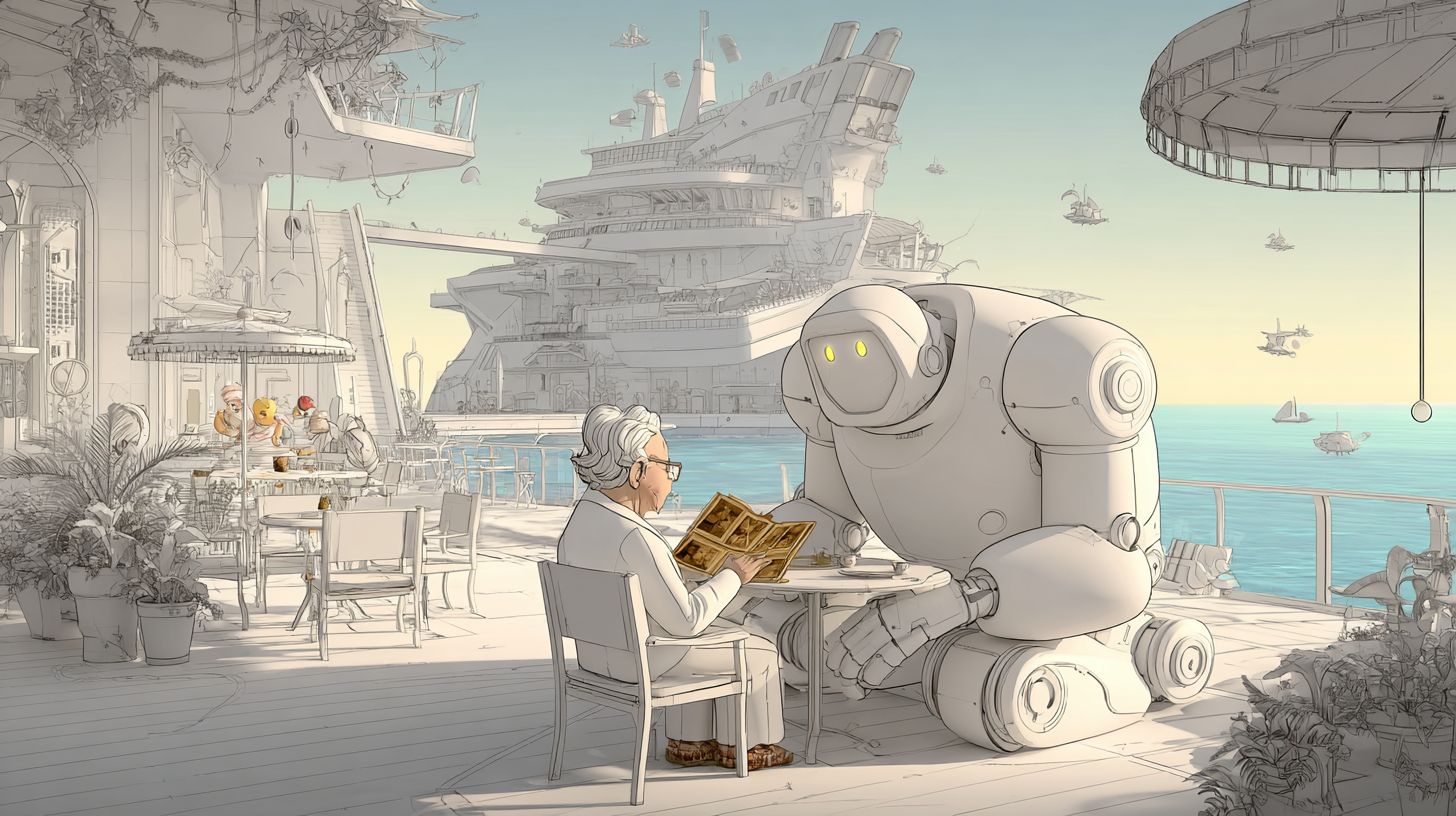
Sim Eternal City is Kang's answer: a four-ship floating city model that integrates memory, aging, and climate displacement into a single urban framework. An 18-minute city — where everything you need is within eighteen minutes — that floats, that moves, and that treats death not as an end to be hidden but as a threshold the city must be designed around.
Kang's route to this book is not the conventional one. He began in Seoul — producing a short film series about romantic love in the city that reached 147 million YouTube views. He moved to New York, where he served as the Seoul Business Agency's official representative for the US East Coast, delivered 10,000 quarantine pouches from Seoul to Brooklyn communities during Covid, and hosted a conference called Death and The City. It was at that conference that the Sim Eternal City framework became inevitable: to speak of the city without speaking of its endings is to see only half of it.
New York is where his book was conceived. It is also the city the book begins with his walk in the stree. The Book Talk event will happen at NYCxDesign 2026 at Cafe Here in Red Hook — a neighborhood that floods regularly, that climate models show disappearing within decades — he will introduce the framework in the city it is most urgently about.
The Kindle edition launches May 1. The paperback follows May 18.
The city he is describing does not exist yet. That, he argues, is the point. You have to imagine it before you can build it.
(Sources: bcd-w.xyz / simeternal.city / NYCxDesign 2026 / IWBFD Storytelling Studios — 2026)
Many Views — São Paulo · London · Tokyo · Singapore · Amsterdam · Nairobi
São Paulo 🇧🇷 — Bruno Carvalho (Harvard University), whose new book The Future City: How We Build What We Cannot Predict was featured in Bloomberg CityLab in March 2026, was born in Brazil and has spent his research career studying Latin American cities — Rio de Janeiro, São Paulo, and the broader urban transformation of the Global South. His argument: cities have always been built from fiction first — from projections, from desires, from stories told about what a place could be before the concrete was poured. São Paulo is one of his central case studies. The city that grew from 240,000 people in 1900 to 22 million today was not planned into existence. It was imagined, narrated, and built — faster than any master plan could accommodate. Carvalho's framing of urban history as a series of narrative acts that precede physical acts is the academic parallel to what Paul Kang is building with Sim Eternal City. The question both are asking: what stories do we need to tell now about the cities we will need in fifty years? In a city like São Paulo, which has already lived through several impossible futures becoming real, that question is not abstract.
London 🇬🇧 — Paul Dobraszczyk, whose book Future Cities (Reaktion Books) has been described as “a breathtaking exploration that intertwines imaginary cities and real-world urban innovations,” writes from London about the deep history of imagined cities — submerged, floating, flying, vertical, underground, ruined, and salvaged. Dobraszczyk argues that there is no clear separation between speculation and reality: in the Netherlands, floating cities are already being built; Dubai's skyscrapers resemble the science-fiction cities of the past; informal settlements in the developing world already look like the dystopian cities of cyberpunk. Sim Eternal City — a floating four-ship city for climate migrants and the aging — lands precisely in the tradition Dobraszczyk is mapping: a city imagined from the edge of what technology and politics currently permit, and therefore showing what comes next. London's experience of sea-level modeling for the Thames Estuary makes Dobraszczyk's work here specific: he is not writing about floating cities as metaphor. He is writing about them as infrastructure.
Tokyo 🇯🇵 — Michael Batty (University College London / MIT), whose book Inventing Future Cities argues that “we cannot predict future cities, but we can invent them,” approaches the future of urban form from the perspective of complexity science. Cities, Batty argues, are organisms rather than machines — they emerge from the bottom up, not the top down, and the only honest response to their unpredictability is continuous invention rather than definitive planning. Tokyo is the city that makes this argument most visibly: a city rebuilt from earthquake and firebombing more than once, a city that never stopped growing when demographers said it would, a city whose transit system works at a level of precision that makes you feel the organism functioning. SusHi Tech Tokyo, which opened this week, is the institutional version of Batty's argument: bring 700 startups to a city, give them real urban problems, and see what gets invented. Sim Eternal City is a parallel experiment in fictional form.

Event Info and RSVP: https://luma.com/ayvw4v2s



Subscribe to Default to read the rest.
Become a paying subscriber of Default to get access to this post and other subscriber-only content.
Collaborator